Monday, October 8, 2012

Last Day In Tokyo

 I wanted to take a break from studying and back track a little.  I meant to post this story about my last day in Tokyo.  I had quite an experience trying to find an ATM that would work for me on that Sunday and Monday before I headed to my language school.  On finally finding one, I decided to spend the last afternoon at a famed onsen on the man-made island of Odaiba.  I read long ago about The Oedo Onsen Monogatari, and though it was supposedly a little hokey, trying too hard to re-create an old Edo (Ancient Tokyo) experience, it still sounded like fun.  Having had no money in my pocket for two days ($13 dollars to my name in this non-credit card oriented city), I suddenly had a sense of freedom.  Before I hopped on the boat that would take me across the Sumida river to Odaiba, I decided to catch a very touristy Rickshaw ride around Asakusa.  I had been watching the Rickshaw drivers for the past three days and, like our American Firemen, the requirements seemed to be that they must be strong, friendly and handsome.  I couldn't resist this indulgence.
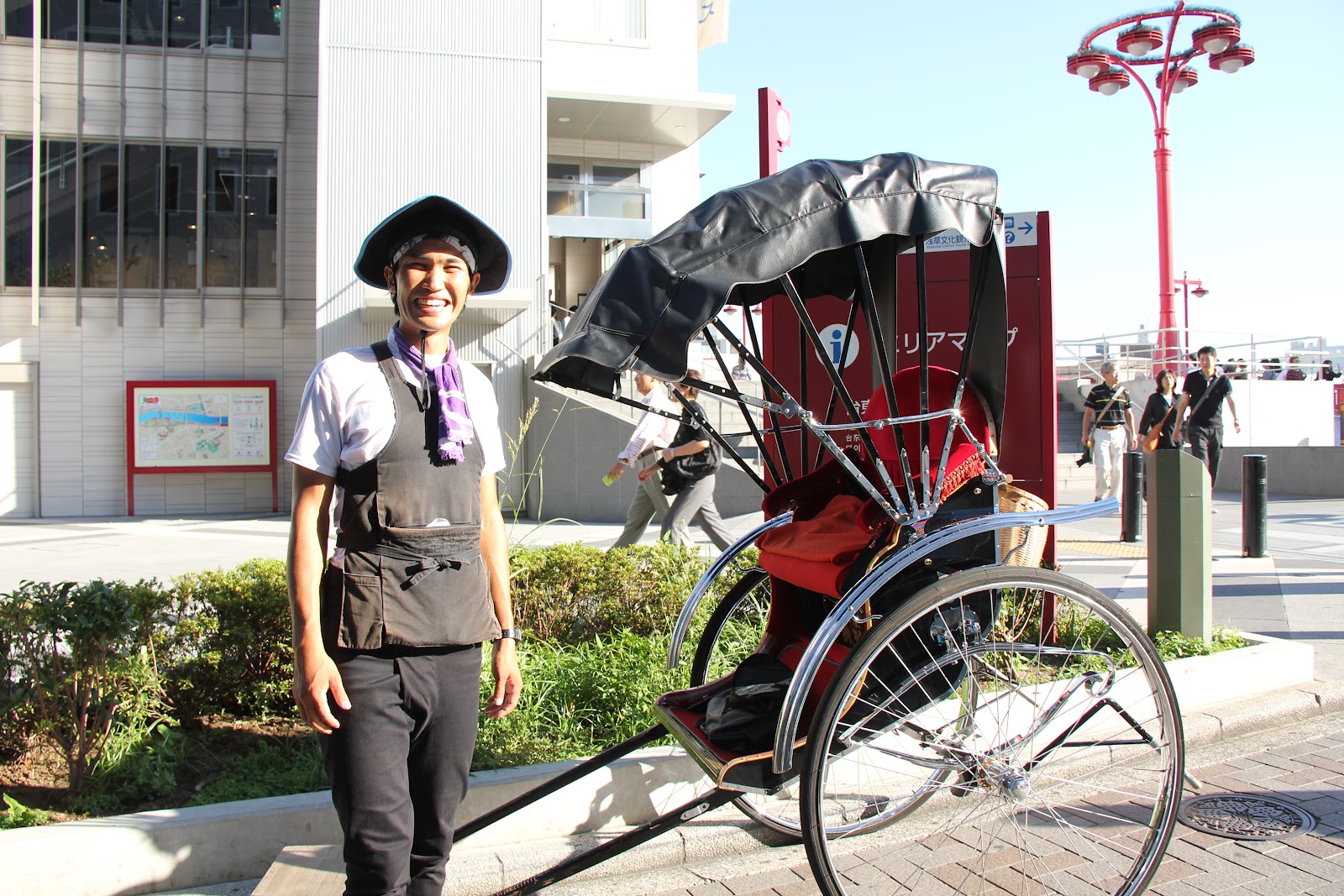
My driver's name was Yoshi and he had studied English for a summer at UC Davis.  He was great at plodding along the streets, pointing out historical detail that I hadn't researched myself, and keeping a conversation going.  When I told him that I was studying writing in a University program he said, "Oh, I am so honored! May I someday read your books?"  I said, "oh, yes, someday!" and we laughed.  I told him that I would probably write about Japan and he stopped the cart, turned around and said, "How very nice of you!"

He was a doll, and it was worth the price, just to talk and joke with this friendly guy...

Later, after a long boat ride, getting lost on  Odaiba island and heading in the wrong direction on the monorail I finally arrived at Oedo Onsen Monogatori, just as the sun was going down.


Although a "re-created" onsen (read, Las Vegas style) with a sand bath, a foot healing stream, 10 indoor baths, 8 outdoor baths, massage, salt scrubs, fish foot therapy, hot stone baths and a beautiful food and bar courtyard, it really is an amazing experience.  Of course, going out into the country side to experience a "real" onsen in the woods is the ideal, but if time doesn't allow, this is a fun option.


By the time I got there it was 5:30.  I was starving, so after getting dressed in my yukkata (simple cotton robe and obi (sash) provided by the onsen) I went into the food court, bought a big bowl of ramen and had a glass of shochu  (Japanese hard liquor)...actually I asked for a sake, but the way I asked she thought I meant this whisky-style drink because all alcohol is categorized under the term Osake.  Well, I wasn't too unhappy about the mix up!

The inner courtyard and shops
By now, I was getting used to being the only Caucasian for miles, and decided that the best recipe for the discomfort of traveling alone like that and being a woman was to appear to be someone studying the culture.  Having a camera in hand and boldly taking pictures as if on a journalistic assignment seemed to work.  Of course, I never directly took a picture of a person, (except for the little girl below, but I asked her father if it was OK). I just got on with enjoying my time and not worrying too much how odd I appeared.

After my quick meal, I headed for the foot stream which was outside in a garden pavilion.  People were hiking up their yukkatas and gingerly walking in the stream.  The stream was embedded with small and then ever larger stones that were supposed to relieve your feet by poking at the pressure points gently.  It was hellishly sharp and I tried not to cry out when I walked over them.  I was one of three gaijin in the entire pavilion, and far be it from me to show that I was a baka gaijin who couldn't handle it.  


The food hall

The entrance to the hot baths.  Women have red noren (curtains), men have blue

Everyone wears a yukkata
This girl is getting a refreshing cup of iced green tea, which is dispensed like water


So I waded all the way to the other end without tears and was quite proud of myself.  Next, I tried the Fish Therapy foot bath.  Apparently this is all the rage all over the world now.  These little fish eat the dead skin off your feet and your feet come out of the bath completely renewed.  They're happy, you're happy.

I sat in a little area of the pavilion with two other women who apparently had been sitting there for awhile.  A few little fish were swirling around their feet.  I put my feet gently in and instantly hundreds and hundreds of tiny fish swarmed my feet. It tickled and I tried not to look down because I was feeling very queasy suddenly.  The women laughed and nodded, like they knew how I felt.

I finally did look down after about two minutes...my feet were covered, like I had on fish boots and I was so terrified suddenly that I shrieked and pulled my feet out of the water.  The women continued to nod at me and I immediately stood up and went to the door.  The manager came to ask if I was alright and I said "Gomen nasai, sukijanai." I'm sorry, I don't like it.  He said, but you have 15 more minutes before they are finished! I bowed and made my exit, he bowed and kept trying to get me to sit down. Arigatou, doumo, doumo I said as I bowed myself out.

Finally, I headed to the baths.  The women's room was giant, the biggest indoor bath I've ever seen.  Multiple tubs of every temperature, with different minerals and salts, wet saunas, dry saunas, scrub rooms.  The rotemburo (outdoor bath) had a bamboo cover and the moon was out.  There was one large outdoor bath and then quite a few barrel baths, made for only one person at a time.

What I love about the Japanese bath culture is that it's just so natural.  Kids are with their moms, girl friends and middle-aged and old-lady friends are just hanging out, talking, laughing, relaxing.  I wish America wasn't so hung up on the naked body.  We could learn a lot from a culture that just hangs out naked together a lot.

I didn't leave the onsen until 11:00 pm.  In six hours I had oodles of time in the baths, a salt scrub, two meals, a glass of shucho and a half pint of beer...it's hard to leave that kind of paradise.

Friday, October 5, 2012

Girl Meets Okazaki

I have been in Okazaki for three days now.  It feels like much more than that.  I arrived on Tuesday afternoon, and after an awkward beginning, (I was picked up at the train station by a distractingly handsome staff member of the Yamasa institute and needless to say, the part of my brain that held what little Japanese I know and understand shut completely off in his presence. Luckily, I regained consciousness, somewhat, within about 15 minutes) I began to settle into my little apartment.  # 102 in Villa 5 -  a set of apartments (Villas 1-5) stacked next to each other about a 12 minute walk away from school.  I had to stock my apartment with goods (a couple of towels, detergent, a bowl, a plate, a cup some paper towels, a pair of hashi, some food and drinks etc. ) from the local department store.   The department store is about 15 minutes walk each way as well so between school and supplying my "pad" I've been getting plenty of exercise.

The apartment is small, but has everything one could need.  A futon loft, a galley kitchen, a separate toilet room and bath room (with a separate shower and deep japanese tub in which to relax), a study space by the window (I use the bar above it as a drying rack for my clothes...the place includes a washing machine)...


The first day of school was Thursday.  I was nervous but knew it was just orientation day.  Nothing could go wrong really.  At the school there is a cross walk where a staff member (not MY staff member though) stands and waits for the students, like a crossing guard at an elementary school. He wears a shirt and tie and black pants.  He holds up a sign and slightly bows and shows you the way to get across the street.  There are never any cars coming at all - this is just a courtesy.

(I have been getting good at returning that kind of bow with just the right bow.  It's more a nod of the head, the lips pressed together tightly, almost smiling but not so much.  The head goes down quickly, as does the other person's head.  Nothing formal, just keep walking.  One might add in a Konnichiwa or a Ohayougozaimasu for emphasis (good day or good morning) but not necessary.)

http://www.animelyrics.com/images/jptest.png
I walked into the classroom to see a gentleman of about my age and two younger Taiwanese women.  The teacher talked with us about where we are from and what our hobbies are, about our work and such.  She was looking for oral skills and also helping us to get to know one another.  After this a long test was issued and we began.  During the test at some point we were pulled out for more oral testing.  When my time came I dropped a lot of particles and often forgot to put sentences in the past tense when I was talking about my trip to Tokyo.  


In the end I was put into what she said was a beginning intermediate class.  Turns out all four of us were put into the same class.  This is unusual because often the students attending have great disparity in skills and proficiency.

The male student, Dave is from Vancouver.  We hung out afterwards and he was kind enough to send me all sorts of links for studying and app recommendations.  Everyone here is very kind and so helpful to each other.

I have to admit that i came home from the super market (after Dave and I parted I headed to get a bento box dinner and a beer) I felt very depressed.  I can't quite make out why.  I think mostly because I feel so insignificant here in a way. Everyone else is here for a month, two months, 6 months, a year.  When I tell people that i'm here for only 2 weeks, it's kind of like why am I bothering? In fact, I feel like the only way to make this trip worth while is to stay for an extra week (three weeks total) so I can get just a heftier amount out of the whole course.  But that probably won't be possible...

The head of school, Declan Murphy, told us later during orientation, that we are required to give a parting speech at the end of our stay.  My heart sunk to my feet.  How ridiculous for me to do that, when others have been here for months!  I am nothing here, not even noticeable.  I told him that must not apply to me.  He said, no it's required of everyone.  Somehow all of this made me go unconscious at about 8:00.  It's been about 10 years since I fell asleep that early.

The next day was today, the first day of class.  I walked to the school and a different staff member (still not MY staff member) was there as a crossing guard.  Doki doki shimshita!  I was nervous! I was entering an ongoing class with people who had been studying there for a long time.  How would I keep up?  I didn't even have the same vocabulary because I've been using a different text book for years.  I dreaded the intensity.  I dreaded having to reveal just how awful I am at this.  Why did I come all this way to be humiliated?  I knew i would have to title my next blog "A lesson in Humiliation."

Sakura House. Click on photo to return to previous file.
Sakura House - Yamasa Coffee shop and Common Room
It helped that Dave-san, Chen-san, and Ro-san were all entering as newbies too.  And it also helped that everyone else in the class is about 23 years old and were all so delightfully easy going.  There's Ken-san from Tiawan, Montero-san from Brazil, Lina-san from Russia, Go-san from Tiawan and Peter-san from New York.  We worked for three hours on the potential form in conversation.  And I never felt at any time that I couldn't keep up.  Three hours passed so quickly. (It's only a half day on Fridays, because they want people to get out and tour around Japan on the weekends.)

After class, Go-san, Montero-san Dave-san and I went to lunch at the cantina next to the school, the Sakura house.  The coffee shop area is called Kitsutsuki (The Wood Pecker) with a bar and television and handful of tables.  Go-san was the most talkative, and we all spoke in Japanese as much as possible.  I realized that this is what I've really wanted all along, to just find people to speak Japanese with, constantly.  To have it as a part of my daily life.   I'm about to experience that for the next 14 days.


Wednesday, October 3, 2012

Tokyo Sky Tree


Sunday, I woke to new stories of Typhoon Jelawat heading towards the city.  My plans had been to try to go to a Swing Dance class in another part of Tokyo (The Tokyo Swing Dance Society has classes in English on Sundays!) then get a boat to Odaiba, a section of Tokyo across the river and spend the rest of the day at the famous Oedo Onsen (bathhouse).  When I asked the receptionist at the desk about the typhoon, she said  (after checking with her manager and also a long research on the computer) that the typhoon was set to hit at about 2:00 so I better be back by 12:00.  There went my plans.

I also needed to buy some essentials and she said I should go to the Sky Tree mall - I had no idea there was a mall there, so why not kill two birds, as they say?

The ride there was easy, just one subway stop away.  Getting out of the station the tower is just above and is literally breathtaking.

Standing in line at the Sky Tree Tower, I kept asking myself, is it worth it?  I have been way up in high buildings before.  I’ve seen city views in Florence, San Francisco, Los Angeles, New York.  But there was an energy that surrounded Tokyo Sky Tree that was undeniable.  The crowds, almost entirely Japanese, were determined, excited and in great spirits. The family behind me played an endless game of Ro-Sham-Bo (though it was called something else) where the father yelled the last word explosively and let out a booming laugh at the end of each and every match.  This delighted the kids, but after about 20 minutes, not me so much.

There was plenty of information to listen to, watch and read as we wound our way through the halls.  Brochures in hand and videos showing the “making of” Sky Tree, one couldn’t miss learning all about it.  The building is 634 meters high, currently the tallest in the world (though, wouldn’t you know it? Shangahi is building something 636 meters right now).   

The design is sleek and ends with a five story pagoda.  Even the two colors they’ve chosen to dress it up at night are traditional Japanese colors that come from the Japanese color pallete known as aijiro – these colors were used hundreds of years ago in cloth dying which was established in 603 by Prince Shōtoku and based on the five Chinese elements.  In this system, rank and social hierarchy were displayed and determined by certain colors.  The blue is called skldjfdsklfjds and represents not only the Sumida River (which winds through Tokyo) but Iki, the manly sprit of urban Edo (Tokyo), its “full strength and intrepid spirit.”  When the tower shines blue, it is only the core of the structure that lights up. 

Every other evening the tower is glamorously purple with glints of golden light, describing for all to see the color Edo-murusaki (royal purple), representing the traditional aesthetics of Japan called Miyabi.  The miyabi lighting shows off the structure of the tower.  And every night a light encircles the tower over and over again showing the passing of time as the light form the tower beams up to the sky to express the hopes and dreams of the people of Japan.


I had been admiring the tower from my hotel room every night and it was fun to learn the specifics and the importance of every detail. 


'Iki', the essence of 'Kokoroiki'.
Iki, the Essence of Kokoroiki - Heart and Straightforwardness


'Miyabi', the Aesthetics.
Miyabi, the Essence of Aesthetics

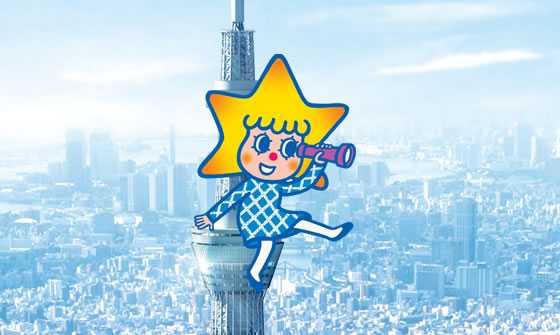
Before we get lost in the elegance of the tower though, this is contemporary Japan after all, so along with the traditional anjiro and delicate balance of male and female representation,  we also need to know that a special and official Character has been created for the Sky Tree as well:  Sorakara-chan! 


Sorakara-chan is a young girl with a star shaped head who descended from the skies to Tokyo Sky tree.  She sticks around Skytree to tell visitors about the delights of the tower.   


Birthplace: The Star Tongari
Favorite phrase: Sora kara, kore kara, ittemiru kara!  (Let’s go explore!)
Prized possession:  Her handy telescope, an heirloom from her grandfather.

There are also other characters, friends of Sorakara-chan:

Sukoburuburu: An old dog bred in shitamachi, the Tokyo traditional town area
Teppenpen: A penguin girl who has a weakness for new fads and fashions.

Ah, Japan.


Once up there,  (riding an elevator with beautifully designed mirrors reflecting cherry blossoms and traveling at 600 meters per minute) it was fun to see how far Tokyo stretches, but without a great knowledge of neighborhoods (I saw the temple in Akasuka right away, however) it looked like infinite buildings reaching as far as the eye can see.  Everyone else was getting a kick out of picking out different areas.  I got a coffee, strolled a little  then left after about 30  minutes. 


The View from a little under 634 meters...


Was it worth it?  In a way.   It’s truly something to say you’ve been to the top of the tallest building in the world.  But to me, the great reward is looking upon it from afar. In the daytime, seeing its presence towering over new Tokyo and old.  And in the evening, admiring  its manly blue, its dazzling purple as it extends straight up to the night sky.  That’s when the Tokyo Sky Tree Tower delights.


Saturday In the Park....


Saturday morning, 5 am shot.

There's nothing like jet lag to get you up and about really early.  I headed down and walked around the area.  To be walking on the Nakamise Dori without a soul there, except for a handful of salary men walking or biking on their way to work...was beautiful. What I love about Japan is the art. Especially the public art.  Everywhere you look, especially in this area, is one gorgeous thing after another.  The shops were all closed, but even the metal doors securing the shops had incredible paintings on them...


Here is Nakamise Dori, a street normally packed with people ...


and the fantastic art work on the metal doors...


And the women's' room.  All mosaics.


Everywhere you look, outstanding art.  I asked later at the information office in front of the temple about the artwork on the metal doors.  The woman said, "Ahh! I didn't know! I have never seen it, I don't come to work before the shops are open.  But we always want people to experience beauty.  Even on a metal door."

Indeed.

As a side note, here is the Nakamise Dori about two hours later:


I headed over to Ueno park to the Tokyo National Museum, which frankly, I felt was a little dry in its presentations.  Yes, they have delicate and lovely original fans. scrolls, kimonos, ukiyo-e, swords, porcelains, calligraphy.  However, the presentation is in dark dark rooms and the tabs for each piece are written dryly.  I was a little disappointed.  


Police Station, Ueno Park


I headed back home and ended up dining on the same little street again, this time eating at another pub in the area, but around the corner.  I knew what to do this time: sit at the bar, face the cooks and the tv, order a small plate and a small beer and get in and out quickly.  Which I did - and avoided the fried chicken skins on a skewer and the braised offal.  


The diety of longevity.  I like him!